

As Indonesia infrastructure rapidly expands, the way international firms enter the local market is shifting dramatically toward more structured and regulated frameworks. Because of this, understanding Foreign Construction Business Entities (“BUJKA“) has become an essential tool for global companies looking to build here legally and successfully.
Table of Contents

The construction services industry is one of the strategic pillars in driving national development. With the increasing demand for infrastructure development and the growing complexity of projects, the presence of Foreign Construction Services Business Entities (“BUJKA”) has become important. The participation of BUJKA in Indonesia is expected to provide added value, particularly in improving the quality of construction outcomes and accelerating the realization of development projects. Nevertheless, the involvement of BUJKA must continue to be regulated in a balanced manner so as not to undermine the strengthening of the capacity of national construction business actors while still safeguarding national interests.
Regulatory Framework Governing Foreign Construction Services Business Entities
The regulations concerning the requirements applicable to BUJKA are governed under Law Number 2 of 2017 concerning Construction Services, as amended by Law Number 6 of 2023 on the Stipulation of Government Regulation in Lieu of Law Number 2 of 2022 on Job Creation as Law (“Construction Services Law”). Meanwhile, Government Regulation Number 22 of 2020, as the implementing regulation of the law, as amended by Government Regulation Number 14 of 2021 (“GR on Construction Services”), does not explicitly regulate the requirements that must be fulfilled by BUJKA to conduct construction services business activities in Indonesia. Nevertheless, the GR Construction Services still contains provisions regarding administrative sanctions that may be imposed if BUJKA fails to comply with the requirements stipulated under the Construction Services Law. Another regulation that must be complied with by BUJKA relates to business licensing, which was previously governed under Government Regulation Number 5 of 2021 concerning Risk-Based Business Licensing and has since been revoked and replaced by Government Regulation Number 28 of 2025 concerning Risk-Based Business Licensing (“GR on Business Licensing”).
In addition, BUJKA must also pay attention to the list of business sectors that are closed or open subject to conditions for foreign investment. The regulation previously governing this matter was Presidential Regulation Number 44 of 2016 concerning the List of Business Sectors Closed to Investment and Business Sectors Open to Investment Subject to Conditions in the Investment Sector (“PR No. 44/2016”), which has been replaced by Presidential Regulation Number 10 of 2021 concerning Investment Business Sectors (“PR No. 10/2021”). A comprehensive discussion of these regulations will be provided in the following section.
Explanation of Construction Services Business Entities in Indonesia
To comprehensively understand BUJKA, it is first necessary to understand Construction Services Business Entities (“BUJK”). As a reference, there is already an article that explains BUJK in greater detail and comprehensively, entitled “The 2026 Construction Law Masterclass: A Practical Blueprint for Navigating Indonesian Construction Law”, written by Irwansyah Dhiaulhaq Mahendra, Miskah Banafsaj, and Dr. Eddy Marek Leks, FCIArb, FSIArb.
Explanation of Foreign Construction Services Business Entities in Indonesia
BUJKA is a business entity established under the laws of and domiciled in a foreign country, having a representative office in Indonesia, and treated as equivalent to a limited liability company engaged in the construction services business sector. As mentioned above, BUJKA may conduct construction services business activities in Indonesia; however, certain requirements must be fulfilled, namely:
- A representative office; and/or
- An Indonesian legal entity engaged in construction services through an equity partnership with a national construction services business entity.
The requirements applicable to each of these forms of BUJKA will be explained further below.
Representative Office
In the case of a representative office, a BUJKA intending to conduct business in Indonesia must satisfy the following requirements:
- Be established as a business entity in its country of origin, with qualifications equivalent to those of a large-scale construction services business entity;
- Obtain the required Business Licenses;
- Establish a joint operation (“JO”) with a national construction services business entity (“BUJKN”) holding large-scale qualifications and the required Business Licenses;
- Employ more Indonesian workers than foreign workers;
- Appoint an Indonesian citizen as the highest-ranking leader of the representative office;
- Prioritize the use of domestic construction materials and technologies;
- Possess high, advanced, efficient, and environmentally friendly technology while taking local wisdom into account;
- Implement technology transfer processes; and
- Fulfill other obligations in accordance with the prevailing laws and regulations.
As explained in point (a), BUJKA must be established as a business entity holding qualifications equivalent to those of a large-scale construction services business entity. The qualifications of construction services business entities are regulated under Article 20 paragraph (1) of Construction Services Law and consist of:
- Small;
- Medium; and
- Large.
The determination of qualifications is carried out through an assessment of:
- Annual sales;
- Financial capacity; and
- Availability of construction personnel.
Since BUJKA is required to hold large-scale qualifications, it may only carry out construction services activities within market segments that are:
- High-risk;
- High-technology; and/or
- High-cost.
BUJKA is a business entity established under the laws of and domiciled in a foreign country, having a representative office in Indonesia, and treated as equivalent to a limited liability company engaged in the construction services business sector.
The provisions regarding large-scale construction services business entities are regulated under Circular Letter of the Director General of Construction Development Number 37/KPTS/DK/2025 concerning the Establishment of Certification Scheme Standards for Construction Services Business Entities (“DGCD Circular Letter”). The relevant provisions are as follows:

It is also important to note that where a BUJKA intends to establish a representative office in Indonesia, it is required to obtain the relevant business licenses. To obtain such business licenses, the representative office must satisfy the following basic requirements:
- Spatial Utilization Activity Conformity (“SUAC”);
- Environmental Approval (“EA”); and
- Building Approval ( “BA”) and Certificate of Proper Function ( “CPF”).
The GR on Business Licensing stipulates that business activities are classified according to their level of risk. For business activities categorized as low-medium risk and high-medium risk, the required business licenses consist of:
- Business Identification Number (“BIN”); and
- Standard Certificate
For business activities categorized as high risk, the required business licenses consist of:
- NIB; and
- License, being an approval issued by the central government, regional government, administrator of a Special Economic Zone, and/or the management body of a Free Trade Zone and Free Port Area, for the conduct of business activities that must be fulfilled by a Business Actor prior to commencing its business activities through the OSS System.
Read More: Legal Aspects of License for the Representative of Foreign Construction Legal Entities in Indonesia
The above requirements must be further elaborated within the construction services sub-sector, where the Standard Certificate for construction services comprises:
- Business Entity Certificate (“BEC”) of construction;
- CWCC Construction; and
- Licenses, namely licenses for BUJK certification bodies and construction services professional certification bodies.
Furthermore, the requirements for conducting construction activities are also regulated under Appendix I H of GR on Business Licensing, namely that the entity:
- Must be a construction services business entity incorporated under the laws of its country of origin; and
- Must pay the administrative fees for business licensing for each business activity in accordance with the prevailing laws and regulations.
Futhermore, Article 33 letter c of the Construction Services Law also stipulates that BUJKA representative office is required to establish JO with a large-scale BUJKN. In this regard, Article 32 Minister of Public Works and Housing Regulation of the Republic of Indonesia Number 09/PRT/M/2019 concerning Guidelines for the Licensing Services of Foreign Construction Services Business Entities (“MR of BUJKA Licensing Services Regulation”) stipulates the criteria must be considered when selecting a BUJKN as a JO partner, namely that the BUJKN:
- Is established as a limited liability company;
- Holds a large-scale BEC and conducts the same business activities as the BUJKA representative office;
- Holds a Construction Services Business License (“CSBL”); and
- Is established as a state-owned enterprise, regional-owned enterprise, or private-owned enterprise whose shares are 100% (one hundred percent) owned by Indonesian citizens and/or national business entities.

Foreign Investment Construction Services Business Entity
A Foreign Investment Construction Services Business Entity (“BUJK PMA”) is a construction services business entity established as a limited liability company through an equity partnership between a BUJKA and BUJKN. Similar to a BUJKA representative office, a BUJK PMA must also satisfy the following principal requirements:
- It must meet the requirements for a large-scale qualification; and
- It must obtain the required business licenses.
As referred to in letter a above, similar to a BUJKA representative office, a BUJK PMA must also satisfy the requirements for a large-scale qualification as regulated under the DGCB Circular Letter, the provisions of which are as follows:

In addition to the requirements described above, both BUJKA representative offices and BUJK PMA are required to submit annual business activity reports containing at least the following information:
- Data on compliance with business licensing requirements;
- Data on the company’s management performance;
- Data on project performance;
- Financial statements; and
- Data on participation in sustainable business development activities.
Capital Structure Requirements for BUJK PMA
As discussed above, foreign investment companies in Indonesia must comply with the prevailing laws and regulations governing business sectors that are open to foreign investment. The capital structure requirements are regulated under Section 5.1.1.2 point (1) of the DGCB Circular Letter concerning BUJK PMA, as follows:
- A non-ASEAN BUJKA may hold a maximum of 67% (sixty-seven percent) of the total shares in a BUJK PMA applying for certification.
- An ASEAN BUJKA may hold a maximum of 70% (seventy percent) of the total shares in a BUJK PMA applying for certification.

Sanctions for Non-Compliance by BUJKA
GR on Construction Services stipulates sanctions for BUJKA that do not comply with the provisions regarding business licensing and BUJKA requirements as stipulated in Article 33 of the Construction Services Law. These sanctions are imposed by the Minister who administers government affairs in the field of public works and public housing. The following are violations and the respective sanctions imposed based on the Construction Services Government Regulation:
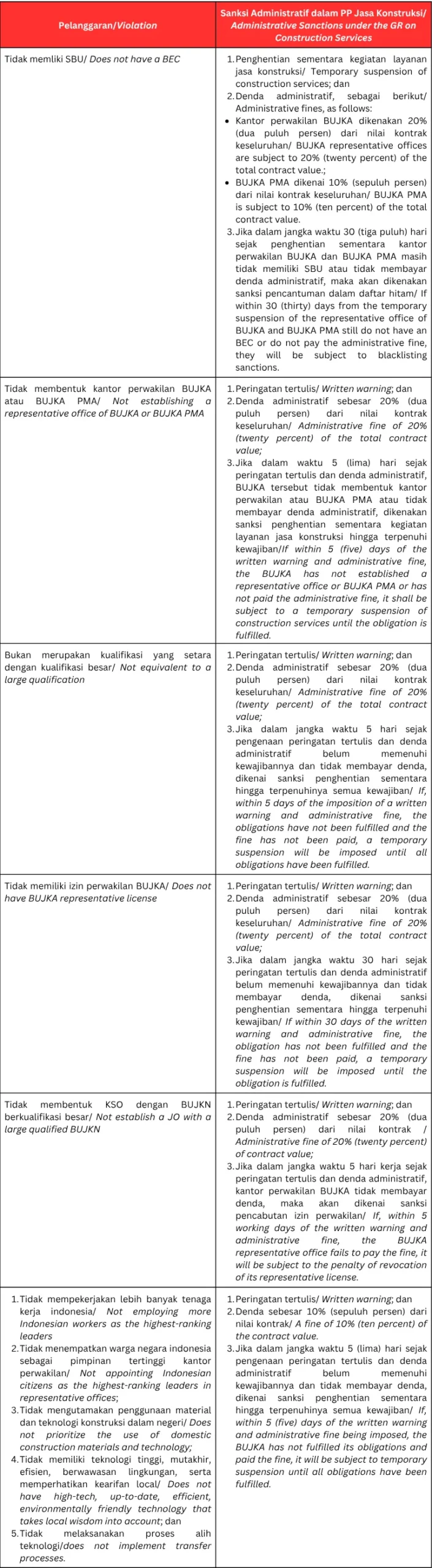
In addition to the GR on Construction Services, GR on Business Licensing also regulates administrative sanctions for the public works and public housing sectors as stipulated in Article 435 of GR on Construction Services. Article 435 of GR on Construction Services stipulates that every business entity in the construction services sub-sector shall be subject to administrative sanctions for violations of:
- Fulfillment of business licensing requirements;
- Fulfillment of the obligation to submit annual business activity reports for construction services in accordance with the provisions of laws and regulations in the field of construction services;
- Fulfillment of specific requirements and obligations for BUJKA PMA or representative offices of BUJKA; and
- Provisions in laws and regulations in the field of construction services.
An ASEAN BUJKA may hold a maximum of 70% (seventy percent) of the total shares in a BUJK PMA applying for certification.
The administrative sanctions are as follows:
- Written warning;
- Imposition of administrative fines;
- Temporary suspension of business activities
- Revocation of the business license; and/or
- Inclusion in the blacklist.
These types of administrative sanctions may be imposed cumulatively or gradually.
Closing
The presence of BUJKA in the provision of construction services in Indonesia reflects the openness of the national construction sector to the participation of foreign business entities, while remaining subject to the framework of Indonesian law. Through the regulations set forth in the prevailing laws and regulations, the government has established various requirements, restrictions, sanctions, and supervisory mechanisms applicable to BUJKA. Therefore, a comprehensive understanding of the legal aspects governing BUJKA is essential to ensure the orderly and fair implementation of construction services, in line with the objectives of national development and the strengthening of the competitiveness of Indonesia’s construction industry.
Author

Raja Salomo is an intern at Leks&Co. He completed his Bachelor of Laws degree at Universitas Gadjah Mada. During his studies, he was active in student organizations, participated in several research and writing programs conducted by the university, and also undertook internships. At Leks&Co, he is assigned to perform legal writing, conduct legal research, and assist with ongoing matters.

Editor

Dr Eddy Marek Leks, FCIArb, FSIArb, is the founder and managing partner of Leks&Co. He has obtained his doctorate degree in philosophy (Jurisprudence) and has been practising law for more than 20 years and is a registered arbitrator of BANI Arbitration Centre, Singapore Institute of Arbitrators, and APIAC. Aside to his practice, the author and editor of several legal books. He led the contribution on the ICLG Construction and Engineering Law 2023 and ICLG International Arbitration 2024 as well as Construction Arbitration by Global Arbitration Review. He was requested as a legal expert on contract/commercial law and real estate law before the court.

Contact Us for Inquiries
If you have any queries, you may contact us through query@lekslawyer.com, visit our website www.lekslawyer.com or visit our blog.lekslawyer.com, real estate law blogs i.e., www.hukumproperti.com and www.indonesiarealestatelaw.com