

Recently there have been various reports in the media concerning the regulations on abandoned land, creating the impression that this new regulatory framework had never previously existed and portraying the government as “alarming” in its authority to confiscate or take over abandoned lands. For instance, in an Instagram post by perupadata on 8 February 2026, the title given was “Resmi: Tanah Telantar Bisa Dikuasai Negara” (Official: Abandoned Land Can Be Controlled by the State). Subsequently, a news in Bisnis Indonesia, published on 3 February 2026, with the title “Prabowo Teken Aturan, Tambang hingga Tanah Hak Milik Telantar Bisa ‘Disita’ Negara” (Prabowo Signs Regulation, Mines to Abandoned Land under Right of Ownership can be ‘Confiscated’ by the State). Further, a news in BBC Indonesia, published on 10 February 2026, titled “Tanah hak milik yang terlantar bisa disita negara, apa motivasi Prabowo?” (Abandoned Land under right of ownership can be confiscated by the State, what is Prabowo’s motivation?).
The news above, if not read in their entirety and with due composure, may trigger unnecessary confusion and panic. In reality, the previous provisions concerning abandoned land that may result in the extinguishment of land rights, are far from new. These provisions originated from the Basic Agrarian Law in 1960. The law stipulates that rights of ownership (hak milik), right to build (hak guna bangunan/HGB), right to cultivate (hak guna usaha/HGU), are extinguished when the land is abandoned.
The provisions of this law are subsequently regulated under several government regulations, starting from the Government Regulation Number 36 of 1998 on the Enforcement and Utilization of Abandoned Land, later replaced by the Government Regulation Number 11 of 2010 under the same title, replaced again following the enactment of the Job Creation Law, namely the Government Regulation Number 20 of 2021 on the Enforcement of Abandoned Areas and Land, which incorporate “area” as a component that may be abandoned. Ultimately, what is currently in effect is the Government Regulation Number 48 of 2025 on the Enforcement of Abandoned Areas and Land.
Substantively, the regulation of abandoned areas and land in 2021 and 2025 is the same
The author finds that substantively the regulation in 2021 and 2025 is the same. The significant differences lie in the provisions concerning the timeframe within the existing steps and in determining when an area begins to become the object to the enforcement of abandoned land, along with the difference in the formulation of legal norms regarding land held under rights of ownership. The regulation of the timeframe under the 2025 regulation is considerably more stringent and tends to be unreasonable for its implementation by permit holders and holders of land rights when compared with the regulation in 2021. The regulation concerning when an area becomes the object to enforcement in the 2025 framework is vaguer and more unclear when compared with the corresponding provisions in the 2021 regulation. Such regulatory ambiguity may weaken the implementation of the more stringent timeframe provisions stipulated in 2025. Nevertheless, the formulation of legal norms regarding land held under rights of ownership in the 2025 regulation is more explicit and more refined compared to the one in 2021.
Similar to the GR 2021, GR 2025 divides the regulation of enforcement between abandoned areas and land. GR 2025 emphasized that every holder of a permit/concession/business permit is obliged to cultivate, use and/or utilize the permit/concession/business permit and/or the area under its possession. Furthermore, all land rights holders, management rights (hak pengelolaan), and land obtained under its possessing-underlying-right are obliged to cultivate, use, utilize and/or maintain the land owned or possessed. Such cultivation and utilization must serve a social function. The social function of land has been emphasized in the basic agrarian law. The GR 2025 explains that the social function requires every party having legal relationship with the land to use the land, maintain the land, improve its fertility, prevent damage, provide access to landlocked plot, and ensure that the land is beneficial to other parties. [The Elucidation of this provision has also been set out in the general elucidation of basic agrarian law when discussing the “social function”. The law explains that it is not justifiable for land to be used solely for personal interest, particularly where such use results in harm to the community.]
The regulation of the timeframe under the 2025 regulation is considerably more stringent and tends to be unreasonable for its implementation by permit holders and holders of land rights when compared with the regulation in 2021.
If an area or land is intentionally not utilized in accordance with legal norms that require every permit holder or rights holder to utilize such area or land, then the area or land becomes subject to the enforcement of the abandoned area or land. The objects of enforcement of the abandoned areas include the following:
- mining;
- plantations;
- industrials;
- tourisms;
- large-scale/integrated housing, or
- other areas related to the land and spatial utilization.
Meanwhile, objects of enforcement of abandoned land include:
- right of ownership (hak milik),
- right to build (hak guna bangunan/HGB),
- right to cultivate (hak guna usaha/HGU),
- right ofo use (hak pakai), and
- land obtained under possession underlying right.
GR 2025 emphasized that land under ownership rights cannot be made an object of enforcement of abandoned land, unless if it is intentionally left unutilized and thus taken over by the public as a settlement area, possessed continuously by another party for 20 years without any legal relationship with the right holder, or the social function of the land is not fulfilled. The formulation of legal norm under the GR 2025 is framed negatively, using the phrase “cannot be”. In contrast, the formulation of the legal norm in GR 2021 is framed positively, whereby “land under ownership right becomes an object of control” with the exception that is essentially the same. Although both formulations ultimately lead to the same result, the formulation of legal norm in GR 2025 is comparatively more reassuring.
The formulation of legal norm under the GR 2025 is framed negatively, using the phrase “cannot be”.
By “intentional” means that, the permit holder does not in fact (de facto) develop an area in accordance with the permit obtained and the development plan. This element of “intentional” is however not fulfilled if:
- such area becomes the object matter in the court;
- cannot be developed due to discrepancies in spatial planning, its physical conditions are not possible to utilize it, the are has not been relinquished (bought over), and the existence of technical problems;
- the area is designated as a conservation area; and/or
- the existence of force majeure.
A similar explanation is also provided for land that is intentionally not utilized or not maintained. In addition, the provisions concerning land further regulate what is meant by “not maintained,” namely the non-implementation of the social function of land, for instance:
- the absence of care in the management and maintenance of the land resulting in a neglected land;
- the land is left to be possessed by other party;
- the absence of care for the land leading to environmental damage and/or disaster; and
- land is used solely for personal interest.
While the meaning of “intentional” has been elaborated in the elucidation, the element of subjectivity in assessing whether the abandonment of an area or land has occurred is inevitable. In the development of large-scale housing, for example, which may be carried out over many years in accordance with a master plan and the developer’s business plan, where only a small portion has been developed while the majority remains undeveloped due to various factors (for instance, low demand), determining that the majority of the land is then considered “abandoned” merely because it is factually not utilized is certainly not easy and will inevitably be subjective. This may be mitigated if the planning for the development of such areas and land is linked to a clear business plan from the applicant, which is considered as an integral part of the permit and land acquisition process, thus the benchmarks used to assess whether “abandonment” has occurred become more objective.
While the meaning of “intentional” has been elaborated in the elucidation, the element of subjectivity in assessing whether the abandonment of an area or land has occurred is inevitable.
Whether for enforcing abandoned areas and land, inventory constitutes the first step. For areas, inventory is carried out since the enactment of the GR 2025 for permits issued before GR 2025 came into effect, at the earliest 2 (two) years if the permit was issued after PP 2025, or upon the expiry of the permit. GR 2021 stipulates that inventory is carried out 2 (two) years from the date of issuance of the permit. The change in the legal norm commencing in the second year (GR 2021) to at the earliest after 2 years (GR 2025), will certainly has a significant impact.
Under GR 2021 inventory is conducted immediately commencing from its second year. Under GR 2025, it is unclear when inventory will be conducted, might be in the second year, third, and so forth. What is clear is that it cannot be conducted before the lapse of the second year. This creates legal uncertainty and gives rise to the possibility of “selective enforcement” by the authorities responsible for conducting the inventory.
For land, inventory is carried out by the Minister, in contrast to the GR 2021, where the authority to conduct the inventory lies with the land office. This change may be because land offices had not carried out the inventory of land and the enforcement of abandoned land in their respective jurisdictions as they should have.
By transferring the authority from the land office to the Minister, it is hopeful that the inventory and enforcement program can be implemented more strictly. The inventory for land is conducted at the earliest two (2) years from the issuance of land rights, management rights, or land obtained under its possessing-underlying-right. This regulation is the same as what was regulated in 2021.
The element of subjectivity may be mitigated if the planning for the development of such areas and land is linked to a clear business plan from the applicant, which is considered as an integral part of the permit and land acquisition process.

Following the inventory, the subsequent stages are evaluation, warning, and determination of an abandoned area or land. The differences in timeframes across all stages can be seen in the table below:
- Comparative Table of Timeframes
- Comparative Table of Timeframes for the Determination of Abandoned Areas
|
No. |
Stages |
Timeframes |
|
|
GR 20/2021 |
GR 48/2025 |
||
|
1. |
Inventory of areas indicated as abandoned |
Conducted 2 years from the issuance of the permit/concession/ business permit issued after GR 20/2021 came into force |
Conducted at the earliest 2 years from the issuance of the permit/concession/ business permit issued after GR 48/2025 came into force |
|
2. |
Evaluation of abandoned areas |
180 days |
60 days |
|
3. |
Warnings of abandoned areas |
||
|
Warning letter 1 |
Implementation period of 180 days |
Implementation period of 30 days |
|
|
Warning letter 2 |
Implementation period of 90 days |
Implementation period of 30 days |
|
|
Warning letter 3 |
Implementation period of 45 days |
Implementation period of 30 days |
|
|
4. |
Determination of abandoned areas |
After the expiration of the third warning letter period |
After the expiration of the third warning letter period |
- Comparative Table of Timeframes for the Determination of Abandoned Land
|
No. |
Stages |
Timeframes |
|
|
GR 20/2021 |
GR 48/2025 |
||
|
1. |
Inventory of land indicated as abandoned |
At the earliest 2 years from the issuance of land rights, management rights, or a basis of control over land, or land obtained under its possessing-underlying-right |
At the earliest 2 years from the issuance of land rights or management rights |
|
2. |
Evaluation of abandoned land |
180 days |
12 days |
|
3. |
Warnings of abandoned land |
||
|
Warning letter 1 |
Implementation period of 90 days |
Implementation period of 14 days |
|
|
Warning letter 2 |
Implementation period of 45 days |
Implementation period of 14 days |
|
|
Warning letter 3 |
Implementation period of 30 days |
Implementation period of 14 days |
|
|
4. |
Proposal for the determination of abandoned land |
No later than 30 days after the expiration of the third warning letter period |
No later than 6 days after the expiration of the third warning letter period |
|
5. |
Vacating of land |
No later than 30 days from the date the land is determined as abandoned |
No later than 30 days from the date the land is determined as abandoned |
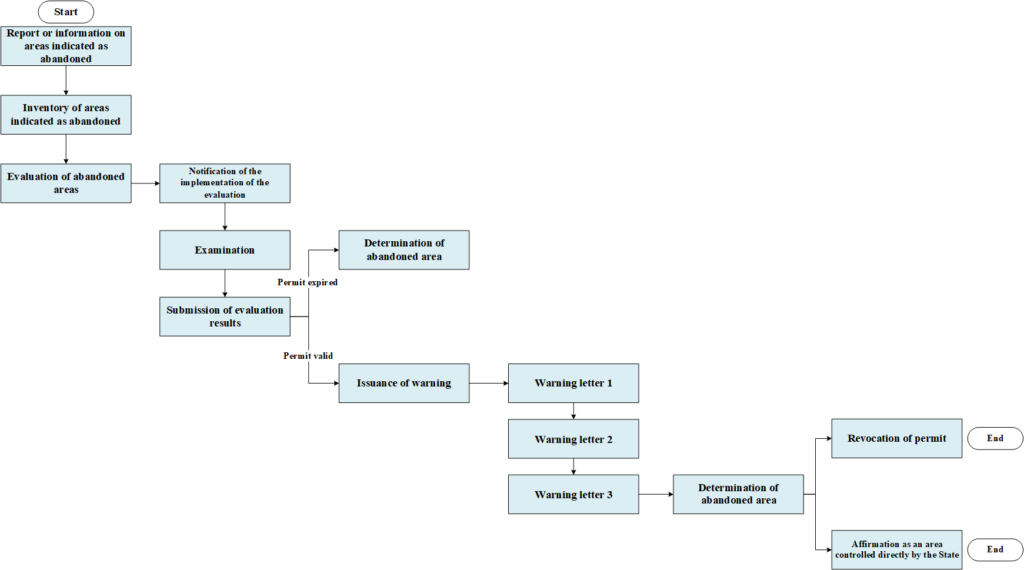
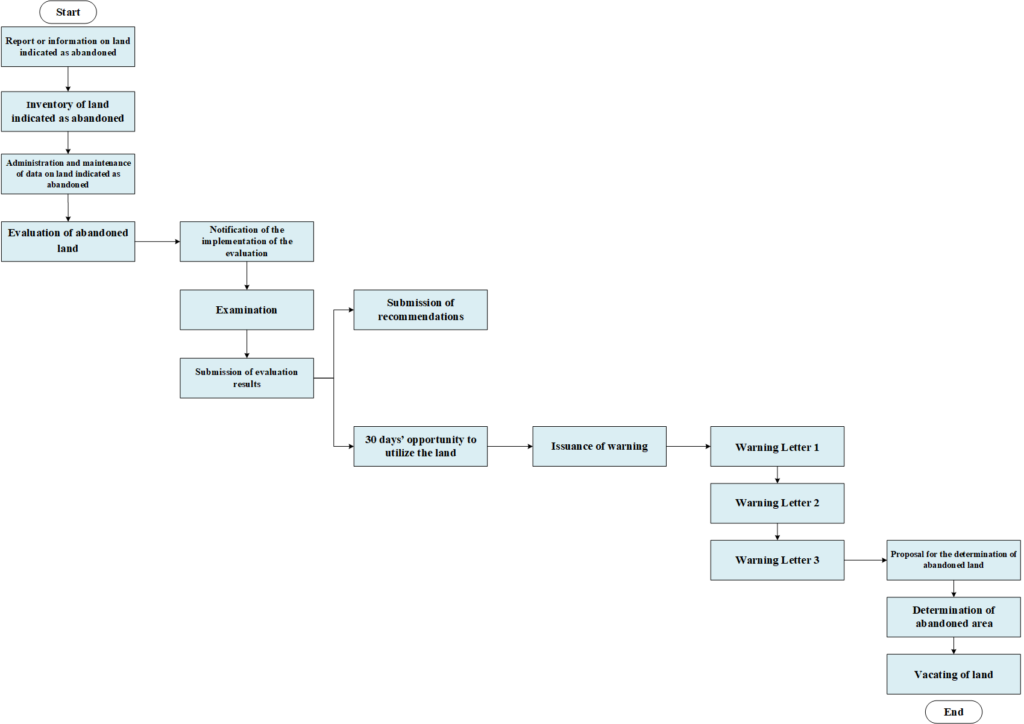
Whereas the flow chart for all stages can be seen in the appendix to this article.
Observing the significantly different timeframes between the GR 2021 and GR 2025, this indicates that the government is very ‘spirited’ to quickly designate an area or land as abandoned. The timeframes provided are almost impossible to comply with by the permit holders or holders of land rights. Is it possible for a parcel of land to be utilized within 14 calendar days? For large-scale housing development plans, for instance, this period may have been used up merely to search for contractors or consultants to undertake certain actions on a portion (not the entirety) of the abandoned land. The period would also highly depend on what was requested to be done, whether a spesific action, or merely a general instruction asking the right holder to do what the land has been planned to be used.
The determination of abandoned areas includes the revocation of permits and/or the affirmation of the area as being directly possessed by the state.

The determination of abandoned areas includes the revocation of permits and/or the affirmation of the area as being directly possessed by the state. Whereas the determination of abandoned land includes the extinguishment of land rights or management rights, the termination of legal relationships, and the affirmation of the land as state land directly possessed by the state. Both abandoned areas and land may be designated as assets of the land bank. Abandoned areas may be transferred to other parties through a transparent and competitive mechanism. Meanwhile, abandoned land may be designated as general state reserve land, for the purposes of:
- agrarian reform;
- national strategic projects;
- land bank;
- other state reserves; and
- certain interests as determined by the Minister.
GR 2025 essentially regulates the same as what was regulated in GR 2021. There are no surprising provisions other than the stricter regulation of time periods during the stages of inventory, evaluation, warning, and determination. This indicates that the government is “spirited” to control abandoned areas and land as quickly as possible. The term “at the earliest” however continues to raise questions and opens the possibility for selective enforcement and collusion. Furthermore, establishing clearer and more objective benchmarks and linking these benchmarks to a binding business plan within the permit, rather than merely looking at “actual (de facto) utilization” becomes the government’s task if the implementation of this regulation is indeed to be carried out in a fair and certain manner.
Flow Chart of the Stages of Determining Abandoned Areas
Flow Chart of the Stages of Determining Abandoned Land
Author

Dr Eddy Marek Leks, FCIArb, FSIArb, is the founder and managing partner of Leks&Co. He has obtained his doctorate degree in philosophy (Jurisprudence) and has been practising law for more than 20 years and is a registered arbitrator of BANI Arbitration Centre, Singapore Institute of Arbitrators, and APIAC. Aside to his practice, the author and editor of several legal books. He led the contribution on the ICLG Construction and Engineering Law 2023 and ICLG International Arbitration 2024 as well as Construction Arbitration by Global Arbitration Review. He was requested as a legal expert on contract/commercial law and real estate law before the court.


Contact Us for Inquiries
If you have any queries, you may contact us through query@lekslawyer.com, visit our website www.lekslawyer.com or visit our blog.lekslawyer.com, real estate law blogs i.e., www.hukumproperti.com and www.indonesiarealestatelaw.com
Sources:
- Unofficial English Translation LAW NUMBER 5 OF 1960 ON FUNDAMENTAL PROVISION OF PRINCIPALS ON AGRARIAN Edited By Eddy M. Leks;
- Government Regulation Number 36 of 1998 on the Enforcement and Utilization of Abandoned Land; (https://peraturan.bpk.go.id/Details/55054/pp-no-36-tahun-1998)
- Government Regulation Number 11 of 2010 on the Enforcement and Utilization of Abandoned Land; (https://peraturan.bpk.go.id/Details/5018/pp-no-11-tahun-2010)
- Government Regulation Number 20 of 2021 on the Enforcement of Abandoned Areas and Land; (https://peraturan.bpk.go.id/Details/161850/pp-no-20-tahun-2021)
- Government Regulation Number 48 of 2025 on the Enforcement of Abandoned Areas and Land; (https://peraturan.bpk.go.id/Details/343426/pp-no-48-tahun-2025)
- Perupadata [@perupadata]. “Resmi: Tanah Telantar Bisa Dikuasai Negara.” Instagram. 2026. Available at https://www.instagram.com/p/DUfuNHwkthr/; (https://www.instagram.com/p/DUfuNHwkthr/)
- Suwikyono, Edi. “Prabowo Teken Aturan, Tambang hingga Tanah Hak Milik Telantar Bisa ‘Disita’ Negara!” bisnis.com. 2026. Available at https://ekonomi.bisnis.com/read/20260203/9/1949581/prabowo-teken-aturan-tambang-hingga-tanah-hak-milik-telantar-bisa-disita-negara#goog_rewarded;
- BBC News Indonesia. “Tanah terlantar bisa disita negara, bagaimana aturan dan kriterianya?” bbc.com. 2026. Available at https://www.bbc.com/indonesia/articles/c1e9pwd6vn0o