

There are various types of dispute and dispute resolution mechanisms available to land and construction disputes in Indonesia, and parties involved in real estate investment, development and construction projects in Indonesia should be aware of these key issues and prepare accordingly.
This article examines the main types of real estate disputes; main methods to resolve real estate disputes; main types of construction disputes; and methods of construction dispute resolution.
Table of Contents

Disputes between parties in private matters or business can occur for a variety of reasons, for example bad faith, breach of contract, negligence, unlawful acts, and coercion. In relation to Indonesian land and construction disputes, there are various types of dispute and dispute resolution mechanisms available, and parties involved in real estate investment, development and construction projects in Indonesia should be aware of these key issues and prepare accordingly. Against this background, this article examines:
- The main types of real estate disputes.
- Main methods to resolve real estate disputes.
- Main types of construction disputes.
- Methods of construction dispute resolution.
Read More: Real Estate Law in Indonesia: A Practical Overview
Real Estate Dispute
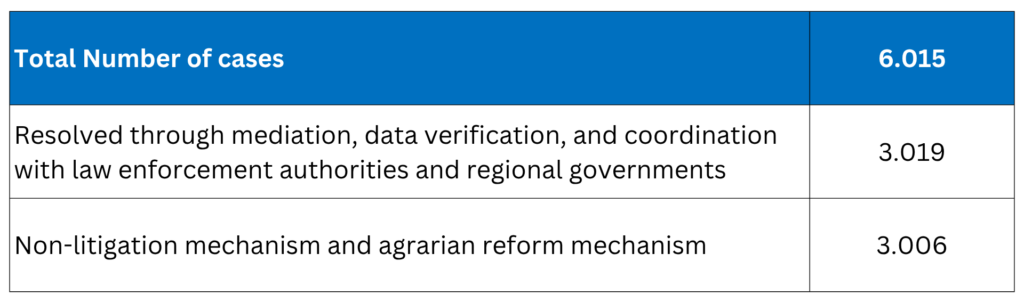
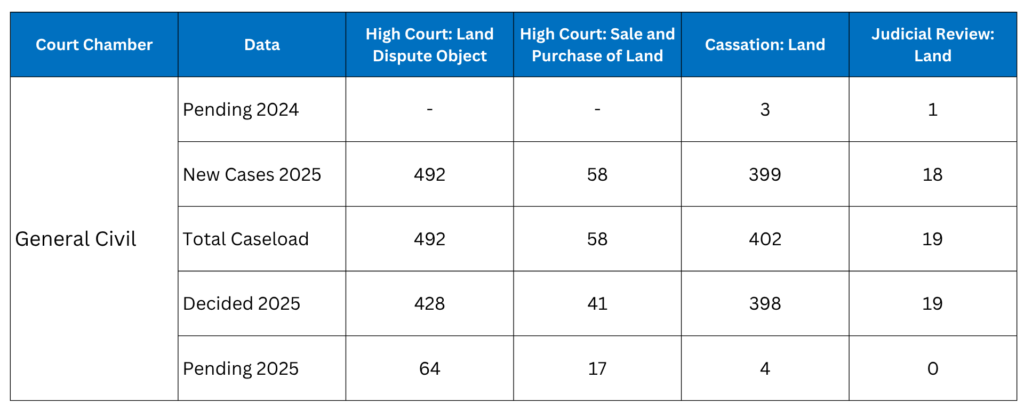
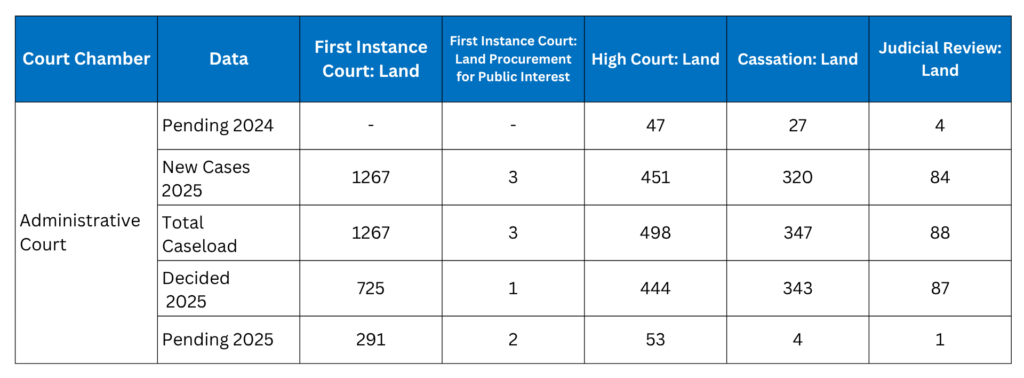
Land disputes in Indonesia may arise in various forms. Based on data from the National Land Agency of Indonesia, the Supreme Court Executive Summary 2025, and the 2025 Annual Report of the Clerk’s Office of the Supreme Court of the Republic of Indonesia, there were more than 3,000 legal cases in the land sector in 2025. To facilitate an understanding of the data on the number of land cases, the information is presented in the following tables:
Land Cases Data from the Ministry of Agrarian and Spatial Planning/National Land Agency (October 2024 to October 2025):1
Land Cases Data from the Supreme Court 2025 Annual Report Executive Summary and the 2025 Annual Report of the Clerk’s Office of the Supreme Court:
The different types of land dispute and their causes relate to the following:
- Land ownership.
- An heir controlling inherited land violates the rights of other heirs.
- Sale of land by an heir to a third party, where the other heirs were not involved. The sale may occur several times.
- Dispute between a holder of a land certificate and a holder of evidence of a controlling right over land that is not yet registered. Many claimants use girik (or other names which essentially is a land information letter for tax purpose) as evidence. A girik is evidence that the land is fiscally registered. In some real estate cases, a holder of girik may still prevail over a land certificate holder provided that certain conditions are fulfilled e.g., if the evidence shows that the land certificate was unlawfully obtained.
- Parties agree to a loan and use a land certificate as security for repayment of the loan. A conditional sale agreement and power of attorney to sell the land are signed at the same time as the loan agreement. When the loan becomes due and the borrower defaults on the loan repayments, the lender will execute the power of attorney to sign the sale agreement, sell the land and use the sale proceeds to satisfy the loan. A dispute can arise if the loan value and the land value are very different. This mechanism is normally not justified by a court since the power of attorney to sell is not considered as a formal security and the conditional sale agreement backing it may be considered as pseudo agreement.
- Dispute between parents and their children, where one of the children sells his parent’s land by falsifying the identity of his parents.
- Parties often sign a deed to transfer land, where the purchase price is not fully paid initially but will be paid in instalments. A dispute can occur when the buyer is unable to make the payments and the land has been transferred to it.
- A landowner sells his unregistered land to third parties repeatedly.
- Land illegally occupied by a third party and some other situations.
When the land has been certificated, the juridical data and physical data of land are clear since the land has been registered and would eventually reduce the legal risk of ownership.

The Validity of Land Documents
The land in Indonesia is not yet fully registered. Some unregistered land may be occupied or controlled by cultivators. The cultivators may then co-operate with local officials to obtain an information letter that they are cultivating the land and/or request that the land and building tax of that land to be issued. In some cases, they will use this evidence to apply to the land agency for a land certificate to the extent they fulfill the requirements for the application of land right.
When an investor is authorized by the government to acquire land for a project, the investor must deal with cultivators that may not be the real cultivators over the land. Thus, prudence principle is important and legal due diligence prior to the acquisition should be made. The investor must pay compensation to all cultivators, so that they will leave the land and relinquish their controlling right over the land back to the state. The investor can then apply for a land certificate over the land from the land agency. When the land has been certificated, the juridical data and physical data of land are clear since the land has been registered and would eventually reduce the legal risk of ownership.
False Land Certificate
A land certificate is regarded as strong evidence of land ownership. However, this may be falsified by an irresponsible party, including a land agency official. In addition, there may be two or three overlapping land certificates relating to the same land. This would probably be the administrative defect or negligence of the land agency when it measured the land before issuing the land certificate.
Since the parties are authorized to own and use the land under the land certificate (even if they overlap), a party can only execute his right in these circumstances through a settlement between the parties having the overlapped lands or settlement through a court.
Falsifying a land certificate is a criminal offense but will most likely have a civil impact. When there is a criminal offense, the criminal investigation and prosecution should be initiated, and the legally binding court’s decision can then be used as evidence to alter the wrong registered data in the land registration system.
Title Restriction
A party, namely an individual, a legal entity, or a law enforcement authority having a lawful legal relationship with the land for which the title restriction is requested, may apply to the land agency to impose a title restriction over certain land (“MR of ASP/NLA 13/2017”). The restriction is valid for 30 days and may be extended by a court order or judgment.2 A dispute can arise when parties want to transfer the land but cannot perform it because the title to the land is restricted. To remove the title restriction, the Land Office may delete the record of the restriction in accordance with the prevailing laws and regulations, including where the restriction has expired, upon the request of the applicant, or pursuant to a final and binding court decision or other legal grounds.3
A land certificate is regarded as strong evidence of land ownership.
This creates problems with the implementation of the land transfer. Prior to the transaction, the Land Conveyancing Officer is obligated by law to check the land before the deed of transfer is signed by the parties.4 In some circumstances, the land can be suddenly restricted by a third party on the closing date.
Title restriction can also occur when there is a claim through a court which then seeks for the seizure of land. If the seizure demand is granted and declared as valid, the land will be seized until the legally binding court’s decision is obtained. Under Indonesian law, seizure of land is classified into the following categories:5
- Civil Seizure. Seizure of the Land Book, Survey Document, or other data requested by a court bailiff or an interested party for the purpose of protecting the object of the dispute.6
- Criminal Seizure. Seizure of the Land Book, Survey Document, or other data requested by an investigator for use as evidence in judicial proceedings, accompanied by the Record of Attachment and the receipt for the attached property.7
- Seizure Based on a Writ of Distress. Registration of a seizure on land rights that constitute the object of a tax debt in accordance with the provisions of the prevailing laws and regulations.8

Other Real Estate Disputes
There are many other types of real estate disputes. Boedi Harsono, in Penyelesaian Sengketa Pertanahan Sesuai Ketentuan- Ketentuan Dalam UUPA (Land Dispute Resolutions according to Provisions in UUPA), summarizes the type of real estate dispute from a legal perspective:
- Land object.
- Land boundaries.
- Land area.
- Land status (state land or land with right).
- Owner of land.
- Pledged right over land.
- Transfer of land.
- Location designation and determination of land area for a government/private project.
- Land relinquishment.
- Land clearance.
- Compensation because of land relinquishment.
- Nullification of land right.
- Revocation of land right.
- Granting of land right.
- Issuing of land certificate.
The title restriction is valid for 30 days and may be extended by a court order or judgment.
Read More: Element of Land Ownership Disputes in State Administrative Disputes
Methods of Real Estate Dispute Resolution
Real estate disputes can be resolved in or out of court (arbitration), but mainly in the court.
Court settlement
Public court. Private disputes between parties are referred to a public court. This type of court generally resolves cases on breach of contract, unlawful act, nullification of agreement, breach of certain legal provisions (for example, limited liability company law), and many others.
Most land disputes are referred to and resolved by a public court. The claimant will usually file a private claim through a district court with jurisdiction over where the land is located or where the defendant is domiciled. If included in the agreement, the claimant will file the claim with the district court jurisdiction as agreed by the parties.
The district court’s decision can be appealed to the high court and requested for cassation to the supreme court. The supreme court’s decision is final, binding, and enforceable. Judicial review as a final resort to re-examine the final and binding court decision can also be requested, if one of the conditions to apply for judicial review is fulfilled.
State administrative court. The state administrative court administers a dispute concerning a state administrative decision, filed by an individual or private legal entity. There are two means to resolve the dispute: administration procedure or claim.
Administration procedure consists of (“Government Administration Law“):
- Objection. This is administrative resolution by the body or state official that issued the state administrative decision.9
- Administrative appeal. This is an administrative resolution by the superior of the government official where the applicant does not accept the resolution of the objection.10
The Court shall have the authority to receive, examine, decide, and resolve government administrative disputes after the administrative procedures have been undertaken (“Supreme Court Regulation No. 6/2018”). An objection shall be submitted in writing to the government body and/or official that issued the decision no later than 21 (twenty-one) working days from the date the decision is announced.11 Government body and/or official shall resolve objections within a maximum of 10 (ten) business days.12 Meanwhile, an administrative appeal may be filed within a maximum of 10 (ten) business days from the date the decision on the objection is received.13
If a citizen is dissatisfied with the resolution of the administrative appeal rendered by the superior of the administrative official, the citizen may file a claim to the court.14
An individual or private legal entity that is aggrieved by a state administrative decision can file a claim against the decision, on the basis that it is against the prevailing laws and regulations and/or violates general principles of good governance. The claimant can include a demand to nullify or declare the decision as unlawful, supplemented with or without a claim for damages.
Objection is an administrative resolution by the body or state official that issued the state administrative decision.
The following are examples of land disputes in the state administrative court:
- Between the land agency and an applicant to register land and obtain a land certificate. In this case, the land agency rejects the application, since it considers the applicant’s land as state land.
- Between the land agency and an applicant, where the land agency rejects the application for registration because there are no documents proving that the applicant is the owner, or there are other parties claiming to be the rightful owner.
- The unlawful certification of land by the land agency.

Out-of-Court Settlement
Alternative dispute resolution (ADR). Under the arbitration and ADR law of 1999, ADR is defined as a mechanism to resolve disputes or differences of opinion through procedures agreed by the parties. Resolution outside the courts can be made by consultation, negotiation, mediation, conciliation, or expert assessment.
Parties that have agreed to settle their dispute through ADR must generally meet within 14 days. The outcome must be set out in a written agreement. If the dispute cannot be resolved by written agreement, the dispute or difference of opinion can be settled through the assistance of one or more expert advisers or a mediator (“Arbitration and ADR Law”).
If the parties fail to reach an agreement within 14 days of the meeting with the assistance of one or more expert advisers or a mediator, or the mediator cannot reconcile the disputed parties, they can request an arbitration or ADR institution to appoint a mediator:15
- Efforts to resolve disputes or differences of opinion through mediation must be performed confidentially.
- A settlement is set out in a written agreement, signed by all the parties. The settlement agreement is final and binding on the parties, implemented in good faith, and must be registered in the district court no more than 30 days after it has been signed.
- The performance by each party set out in the settlement agreement must be completely implemented no more than 30 days after it is registered.
Resolution outside the courts can be made by consultation, negotiation, mediation, conciliation, or expert assessment.
Arbitration. Arbitration is one of the best-known mechanisms to resolve disputes out of court. The basis of arbitration is the arbitration agreement. Without it, arbitration cannot be used by the parties, unless it is agreed after the dispute has arisen.
The parties can resolve disputes through an arbitration institution or ad-hoc. It is quite common now to refer disputes to an arbitration institution, for example the Indonesian National Arbitration Board (Badan Arbitrase Nasional Indonesia, BANI). BANI has its own arbitration procedure.
For ad-hoc arbitration, the parties must adopt an arbitration procedure issued by the arbitration institution or draft their own procedures.
International arbitration has become increasingly popular, due to the New York Convention of 1958 and the liberalization of trade and services and the Association of Southeast Asian Nations Economic Community (ASEAN) that has been commenced since 2015. Based on the data provided by the Investment Coordinating Body, the foreign investment to Indonesia in 2025 has achieved Rp900.9 trillion,16 and in Semester 1 2026, foreign investment to Indonesia achieved Rp507.6 trillion.17 These foreign investments involve foreign investors with their own preferred arbitral body that can and will be referred to resolve disputes with their local partners in Indonesia. International arbitration in Indonesia involves ICC, SIAC, AIAC, HKIAC, and CIETAC.
The District Court of Central Jakarta has authority to handle the recognition and enforcement of international arbitration awards. They are only recognized and enforceable in Indonesia if they fulfil the following requirements:
- The award must have been rendered by an arbitrator or arbitration tribunal in a country which, together with Indonesia, is a party to a bilateral or multilateral treaty on the recognition and enforcement of international arbitration awards.
- The award falls within the scope of commercial law, according to Indonesian law.
- The award does not violate public policy.
- An exequatur order has been obtained from the chief judge of the District Court of Central Jakarta.
Since land law has private and public elements, most land disputes are referred to courts. This is the natural tendency among parties in Indonesia.
The District Court of Central Jakarta has authority to handle the recognition and enforcement of international arbitration awards.
However, it is possible to settle land dispute through arbitration, if it is explicitly agreed by the parties, such as disputes between a foreign investment company and a local limited company in Indonesia. For example, in the purchase agreement, the parties may agree to settle and refer disputes to an international arbitration institution. Its award may be considered as an international arbitration award under Indonesian law and enforceable after fulfilling the requirements under the law.

Construction Disputes
Real estate and construction are different but closely related subjects. Every real estate development will involve construction services and therefore will refer to a construction contract.
In addition, the smooth operation and implementation of construction will result in the smooth completion of the real estate project, as well as delivery to the buyers of property units. If the operation and completion of construction are not on schedule, it may result in a claim of damages against the real estate developers, and in return may result in a claim of damages against the contractor.
Read More: The Future of Construction in Indonesia: Embracing True Sustainability
Accordingly, it is imperative to understand the legal risks that may occur along the way and stipulate their mitigation through clauses in the contract.
Construction claims or disputes can be in different forms. They can originate from an owner or contractor, or between a sub-contractor and contractor. The causes of disputes can therefore depend on the parties’ roles.
Professor H. Priyatna Abdurrasyid, in Arbitration & Alternative Dispute Resolution – An Introduction, states that the causes of construction claims are:
- Inadequate site investigation.
- Delayed design information.
- Inadequate design information.
- Slow client response.
- Poor communication.
- Unrealistic time frame.
- Inadequate contract administration.
- Uncontrollable external events.
- Incomplete tender information.
- Unclear risk allocation.
- Lateness or non-payment.
Further, Robert D Gilbreath, in Managing Construction Contracts, writes that in general, owners file claims against their contractors (and, for that matter, engineering firms or other consultants) for one or more of the following reasons:
- Defective work. Owners not satisfied with the contractor’s product can claim damages that include the cost of repair, replacement, or removal of the defective work. In most cases the work does not meet the contractual specifications or is otherwise not fit for its intended purposes. Occasionally, the goods or services do not meet express or implied warranties provided by the contractor or its suppliers.
- Delay caused by the contractor. If the contractor has obligated itself to perform the contract work, in whole or part by a specified time, the owner can claim damages when a delay was not beyond the control of the contractor. Typical damages claimed by owners in this regard are loss of use of the facility, the ripple effect on other contractors, and the increased cost of other delayed work.
- A defense and counterclaim. Owners faced with claims from contractors can make a counterclaim. This usually counters, or attempts to discredit, the contractor claim, by uncovering overlapping or duplicate cost claims. For example, citing changes or provisions in the contract that prohibit or modify the contractor’s right to claim in the event of a dispute.
Other types of claims, though rare, arise from termination or breach of contract. This generally occurs when a contractor fails to complete the work or for some reason leaves or abandon the job site. Owners in this situation usually demand to be compensated for the increased cost, over and above that was paid to the contractor, for completing the work through other means.
In contrast, from the contractor’s perspective, Robert D Gilbreath summarizes the following causes of claims:
- Late or defective owner-provided information, generally in the form of a drawing or specification.
- Late or defective owner-provided information, generally in the form of drawing or specification.
- Late or defective owner-provided material or equipment.
- Changes in regulatory requirements, drawings, or specifications.
- Changed or unknown site conditions.
- The ripple effect or collateral work.
- Restrictions in work method, including delay or acceleration of contractor’s performance.
- Ambiguous contracts or contract interpretation.
In each situation above, the contractor will claim that something has occurred (or failed to occur) that caused it to incur additional cost or spend additional time, beyond that called for in the contract or that could have been reasonably expected at the time of bidding or contract award.
Construction claims or disputes can be in different forms, either from an owner or contractor, or between a sub-contractor and contractor.
Contractors can also claim damages when they feel they have been unjustly removed from a project or otherwise prevented from completing their work. These situations can arise when the contract, in effect, has been terminated by one party.

Methods of Construction Dispute Resolution
Construction dispute resolution is like any other dispute resolution. Construction disputes can be resolved in or out of court. Indonesia construction law clearly provides that the basic principle of construction dispute resolution is settlement through deliberation to reach a mutual agreement (“Construction Services Law“). If this cannot be achieved, the parties shall pursue the dispute resolution mechanism stipulated in the construction services contract.18 However, if such mechanism is not stipulated in the construction services contract, the parties may determine the dispute resolution procedure, provided that such procedure is set out in a written agreement.19
A construction dispute in court is filed with a public court. It will not be filed with a state administrative court, unless it relates to a state administrative decision. Most claims are based on a breach of contract. A claim of an unlawful act is still possible, depending on the legal issues and context.
In Indonesia, especially in the construction industry, ADR is becoming increasingly recognized and used by the parties. This is because a court dispute takes much longer than an out of court settlement. Adjudication and arbitration are two of the popular ADR mechanisms in construction sector.
Adjudication. Adjudication is a familiar means with construction players. In the Construction Contracts Dictionary by Chow Kok Fong, adjudication is defined as the act of formally deciding or determining a dispute or matter in the courts or other tribunals. Black’s Law Dictionary defines adjudication as the legal process of resolving a dispute; the process of judicially deciding a case. Adjudication may have different forms, depending on the parties’ agreement. However, adjudication is essentially a dispute settlement that involves the adjudication board. The decision by the adjudication board can be final and binding, without waiving the right of the unsatisfied party to challenge the decision by adjudication board to either to arbitration or court, as agreed by the parties. Under the Construction Law, the parties are allowed to resolve disputes through a dispute adjudication board, in addition to mediation and conciliation.20 A dispute adjudication board is a panel established by mutual agreement of the parties upon the execution of a construction services contract to prevent and mediate disputes arising during the implementation of the project set forth under the construction services contract.21
Mediation and conciliation. It is essential to note that Indonesian law regulates in more detail ADR in the construction industry. A dispute can be settled out of court through a third party by mediation (appointed by the parties or arbitration institution), conciliation, or arbitration. An expert appraiser may be involved in either mediation or conciliation to provide professional consideration as required by the parties.
The following are the conditions for mediation:22
- One mediator appointed by the parties in dispute.23
- The mediator has a professional certificate.24
- The mediator can request assistance by an expert appraiser, if necessary.25
- The mediator acts as a facilitator to guide the disputed parties to arrange a meeting and reach a settlement.
- The settlement is made in writing.26
The above conditions were previously regulated under a Government Regulation number 29 of 2000 on Construction Services but has been revoked by Government Regulation number 22 of 2020 on the Implementing Regulation of Law Number 2 of 2017 on Construction Services. However, those conditions are essentially regulated under the Supreme Court regulation on court-annexed mediation procedures.
The following are the conditions for conciliation:27
- One conciliator is appointed by the disputed parties.
- The conciliator has a professional certificate.
- The conciliator prepares a proposal for settlement.
- If the proposal is agreed by the parties, the solution made by the conciliator becomes the proposal for resolution.
- The proposal for resolution is made in writing.
The parties are allowed to resolve disputes through a dispute adjudication board, in addition to mediation and conciliation.
Construction Arbitration
Arbitration Clause
According to Indonesian Law, dispute resolution through an arbitration is based on an arbitration agreement. The arbitration agreement waives the jurisdiction of the court to try the dispute.
Mechanism and Time Frame of the Arbitration Proceeding
The arbitration proceeding should be completed no later than 180 (one hundred and eighty) days since the arbitral tribunal is formed, in private, and using the Indonesian language unless agreed otherwise. The mechanism of an arbitration proceeding will involve:
- submission of claim;
- submission of answer by the respondent within 14 (fourteen) days since a copy of the claim was received;
- attempt of amicable settlement by the tribunal. Should the settlement be reached, the tribunal draws up a deed of settlement which is final and binding, and if the amicable attempt is unsuccessful, the proceeding will continue;
- both parties are given the last opportunity to explain each standpoint in writing and present evidence which is deemed necessary to support their standpoints within a period determined by the tribunal;
- examination of witnesses and experts before the tribunal are conducted based on the civil procedural law;
- rendering the final and binding award;
- within a maximum period of 30 (thirty) days after the decision is rendered, the arbitration award shall be submitted and registered by the arbitrator or his/her proxy to the district court. If this point is not fulfilled, the arbitration award cannot be enforced; and
- if the parties do not voluntarily enforce the arbitration award, it shall be enforced based on an order from the head of the district court, upon request from one of the disputing parties.
The arbitration agreement waives the jurisdiction of the court to try the dispute.
Choice of Laws, Seat, Arbitrator, and Language
Construction services contracts executed in Indonesia to be governed by Indonesian law.28 Nevertheless, the parties are free to choose the law of the arbitration agreement, seat of arbitration, arbitral rules, arbitrators and the language of the arbitration since there is no restriction under the construction law. Regarding the language of the contract, the construction law stipulates that if the construction contract is executed with a foreign party, it shall be made in the Indonesian language and English, with Indonesian being the prevailing language.29
Multi-party Disputes Involving Contractors and Subcontractors
Since construction contract is interconnected, disputes between employer and contractor may have impacted or have connection with disputes between contractor and its subcontractors. When each has separate arbitration agreement, it may sometimes hard to resolve the issues or disputes among the parties altogether. But this setback should now be resolved with the ability of the arbitral institution to deal with disputes involving many parties and many different agreements if they are connected and have chosen a certain institution or a certain institutional rule as its choice of forum.

Interim Award
Arbitration and ADR law stipulates that upon the request from one of the parties, the arbitrator or arbitral tribunal may render a provisional award or interlocutory award.30 Therefore, such party can obtain an interim award if it expressly requests the interim award in its claim or in its request for arbitration. Furthermore, the term for the implementation of the provisional decision or interim decision is not counted in the specified term of the arbitration process of 180 (one hundred and eighty) days as described above.
Read More: The Ultimate Guide to Foreign Construction Services Business Entities in Indonesia
Construction services contracts executed in Indonesia to be governed by Indonesian law.
Parallel Proceeding on a Construction Dispute
Where it has been agreed that the dispute will be resolved by arbitration, neither party will be able to bring a parallel proceeding, since the court has no jurisdiction to examine the dispute between the parties where there is an arbitration agreement. Moreover, the court is also obliged to reject any dispute resolution submission that includes an arbitration agreement therein.31
Setting Aside of the Arbitral Award
Any party may apply for setting aside the arbitration award if the award allegedly contains the following elements:32
- letters or documents submitted in the proceeding which are admitted being false or declared as false;
- there is a decisive document found concealed by the opposing party; or
- the award was rendered based on deceit by one of the parties in the proceeding.
The application must be submitted in writing no later than 30 (thirty) days from the submission and registration of the award at the district court.33
International Arbitral Award Recognition and Enforcement
International arbitral award is an award rendered by an arbitration institution or sole arbitrator outside the territory of Indonesia or which according to Indonesian law is categorized as an international arbitral award (“Supreme Court Regulation No. 3/2023”). In order to be enforced in Indonesia, an international arbitral award must first be registered to the Central Jakarta District Court. After being registered, the award can be applied for exequatur and then can be enforced.34 To understand the registration of the international arbitral award and its enforcement, please read Enforcement of International Arbitration Award in Indonesia by Yosefin Mulyaningtyas.
Emergency Arbitration Procedure According to BANI Rules 2025
BANI Rules 2025 provides for an emergency arbitration. That feature allows a party seeking urgent interim or conservatory measures prior to the constitution of the arbitration tribunal to apply for emergency arbitration,with the purpose to seek an urgent temporary relief from an emergency arbitrator. This feature may be useful in situations where waiting for the full arbitral tribunal to be formally constituted would cause a party to suffer any irreparable harm. To read this matter in more detail, please read Emergency Arbitration in 2025 BANI Rules.
Author

Dr Eddy Marek Leks, FCIArb, FSIArb, is the founder and managing partner of Leks&Co. He has obtained his doctorate degree in philosophy (Jurisprudence) and has been practising law for more than 20 years and is a registered arbitrator of BANI Arbitration Centre, Singapore Institute of Arbitrators, and APIAC. Aside to his practice, the author and editor of several legal books. He led the contribution on the ICLG Construction and Engineering Law 2023 and ICLG International Arbitration 2024 as well as Construction Arbitration by Global Arbitration Review. He was requested as a legal expert on contract/commercial law and real estate law before the court.


Assisted by

Raja Salomo is an intern at Leks&Co. He completed his Bachelor of Laws degree at Universitas Gadjah Mada. During his studies, he was active in student organizations, participated in several research and writing programs conducted by the university, and also undertook internships. At Leks&Co, he is assigned to perform legal writing, conduct legal research, and assist with ongoing matters.
Contact Us for Inquiries
If you have any queries, you may contact us through query@lekslawyer.com, visit our website www.lekslawyer.com or visit our blog.lekslawyer.com, real estate law blogs i.e., www.hukumproperti.com and www.indonesiarealestatelaw.com
References:
- MR of ASP/NLA 13/2017
- Law Number 5 of 1986 on the State Administrative Court
- Government Administration Law
- Supreme Court Regulation No. 6/2018
- Arbitration and ADR Law
- Job Creation Law Law No. 6 of 2023 on the Stipulation of Government Regulation in Lieu of Law No. 2 of 2022
- Construction Services Law
- Supreme Court Regulation No. 3/2023
Sources
- Arina Widya Kurniawati, atrbpn.go.id, < https://www.atrbpn.go.id/berita/setahun-menteri-nusron-selesaikan-3019-kasus-pertanahan-cegah-kerugian-rp967-triliun>, 2026, accessed on 17 July 2026
- Article 13 MR of ASP/NLA 13/2017
- Article 15 MR of ASP/NLA 13/2017
- Article 97 paragraph (1) of Regulation of Minister of Agrarian and Spatial Planning/Head of National Land Agency Number 16 of 2021 on Third Amendment of Regulation of State Minister of Agrarian/Head of National Land Agency Number 3 of 1997
- Article 26 MR of ASP/NLA 13/2017
- Article 1 number 4 MR of ASP/NLA 13/2017
- Article 1 number 5 MR of ASP/NLA 13/2017
- Article 26 paragraph (4) MR of ASP/NLA 13/2017
- Article 76 paragraph (1) Government Administration Law
- Article 76 paragraph (2) Government Administration Law
- Article 77 paragraph (1) and (2) Government Administration Law
- Article 77 paragraph (4) Government Administration Law
- Article 78 paragraph (1) and (2) Government Administration Law
- Article 76 paragraph (3) Government Administration Law
- Article 6 paragraph (4) and (6) Arbitration and ADR Law
- Kementerian Investasi dan Hilirisasi/BKPM, BKPM.go.id, <https://www.bkpm.go.id/en/info/press-release/investment-realization-in-2025-exceeds-target-downstream-investment-jumps-43-3-percent>, 2026, accessed on 21 July 2026
- Kementerian Investasi dan Hilirisasi/BKPM, BKPM.go.id, < https://www.bkpm.go.id/id/info/siaran-pers/realisasi-investasi-semester-i-2026-tembus-rp-1-010-t-serap-1-4-juta-tenaga-kerja-langsung>, 2026, accessed on 21 July 2026
- Article 88 paragraph (2) Construction Services Law
- Article 88 paragraph (3) Construction Services Law
- Article 88 paragraph (5) Construction Services Law
- Elucidation of Article 88 paragraph (5) of Construction Services Law
- Article 50 GR 29/2000, has been revoked by GR 22/2020
- Article 19 paragraph (1) Perma 1/2016
- Article 13 paragraph (1) Perma 1/2016
- Article 26 paragraph (1) SCR 1/2016
- Article 27 paragraph (1) SCR 1/2016
- The conditions for conciliation have previously been regulated under the Article 51 GR 29/2000 but this regulation has been revoked by GR 22/2020
- Article 75 paragraph (2) of Government Regulation No. 22 of 2020 on Implementing Regulation of Construction Law
- Article 50 of the Law No. 2 of 2017 on Construction Services
- Article 32 of the Arbitration and ADR Law
- Article 11 paragraph (2) of the Arbitration and ADR Law
- Article 70 of the Arbitration and ADR Law
- Article 71 of the Arbitration and ADR Law
- Article 66 and 67 of Arbitration and ADR Law